Read time: 10 minutes
As many of you know, I decided to take some time out from working a few years back. So, using my hard-earned savings, I embarked upon a series of adventures exploring people and places.
One of the areas I decided to explore was my family history. I’ve always been fascinated by history and as a child, I obsessively read stories set in the past.
It didn’t occur to me until I was growing older that there were also wonderful stories from the past where my own family were the main characters.
Once I started exploring my ancestry, I found myself cursing how little attention I had paid to my older relatives, particularly my grandfather who would show me pictures of long-gone relatives.
He was in the grip of dementia at the time, and he expected me to remember these people despite the fact that most of them had died decades before I was born.
It was one of many things he was confused and obsessive about, so I ended up focusing more on the inaccuracy of what he was saying rather than the interesting story behind it.
How I wish I could go back in time and change my response to him.
Turn back time
I’ve often wished I could turn back time.
Sometimes, it’s with the aim of reliving a conversation to improve it – most likely by adding a sassy comment that I only thought about after the conversation had ended.
Mostly though, I’ve wanted to experience the world as it was before.
As a child reading about kings and queens in Medieval times, I wished I could travel back in time to see them in real life.
To be fully present and dress up in the same rich clothing, to feel the weight of it bustle against my legs as I march with purpose through an old stone castle.
When I think about it, I can almost feel the cold draught whistling through the wall tapestries, the dim light of the ensconced candles flickering with the breeze.
And the smells: lots of odours from animals, rotting food and, of course, sweat and grime from people who rarely bathe and have different toilet habits.
Not pleasant but an important part of the experience.
I imagine myself being transported in a horse drawn carriage, bouncing along cobbles and rough terrain, the horses neighing occasionally.
The horses…
Damn it.
This idea of travelling back in time always comes unstuck when it comes to horses because I have a severe allergy to them.
Instead of seeing a version where I seamlessly fit into history, I see instead a reality where I have a massive allergic response resulting in me wheezing through a face swollen with hives.
So twisted will my face be, that they will mistake me as a gargoyle and as a result, I will be put to death without ever being able to return to my own time to tell the stories of what I experienced.
This time travel idea clearly needs some work.
Other ways to travel back in time
Unable to see a possibility where I could physically travel back in time – I’m not even considering the quantum physics involved in making it happen – I have concentrated instead on travelling back in time through photos and documents.
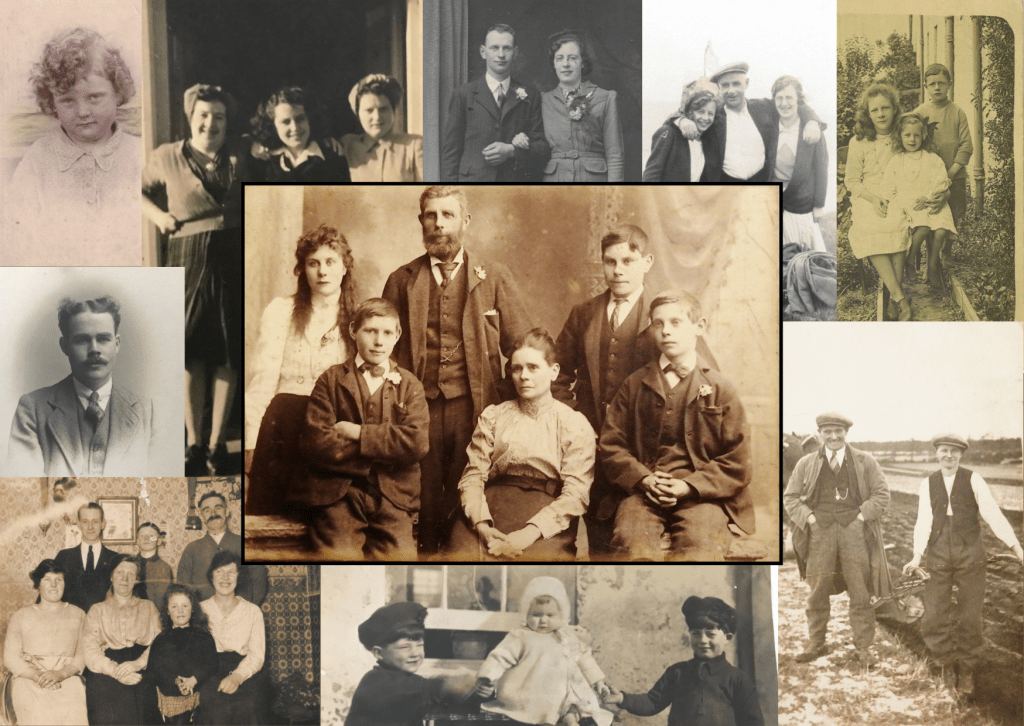
I have harassed many of my relatives for old photos that will help me see what my ancestors looked like.
When I find an old photo, I find myself focusing on my ancestor’s eyes, as if the intensity of my gaze will make them come alive so they can show me their true personality.
Of course, many of the photos were only taken within the last one hundred years so I have to rely instead on official records for anyone who lived prior to this period.
I have spent a lot of time reading through fragile school and church records as well as trawling through the vast array of online documents available to the intrepid family historian.
Finding a document with my three-times great-grandfather’s signature immediately transported me back in time.
I traced his signature, imagining the hand that wrote it.
Was it a hand knotted with calluses from his work as a cattle dealer? I don’t have any way of knowing for certain.
I do know that he suffered from chronic bronchitis for much of his life and I learned that the housing of the time tended towards dampness, heated by open peat fires which could only have exacerbated his condition.
Furthermore, the mere presence of his signature told me that he could write, something not universal at the time.
His sister, for example, had to put a cross as her mark on an official document because she was unable to write.
These tiny details, which may seem insignificant to some, help to turn each of my ancestors into a more rounded person rather than just a collection of facts.
So whilst I might not have been able to travel back in time in the exact way that I might have wished for, these details, together with a sprinkling of imagination, allow me to create a story about each person.
It’s all in the past – move on
Some people might wonder why we should bother exploring our family history – surely it’s all in the past?
And, yes, to some degree that’s true. We have to be wary about dwelling on the past so much that it inhibits us from moving forward.
But what if we needed to study our past in order to move forward?
One of my favourite quotes is ‘An arrow can only be shot by pulling backwards’.
There are a few variations of this quote but they all share the theme that in order to move forwards, we may first have to be pulled back.
We might be pulled back into difficult situations or have to face up to some uncomfortable truths before we can move on.
Many people might just think this applies to a period within their own lifetimes but what if generations of behavioural patterns are keeping us stuck in the same loop?
Many of our behaviours come from our upbringing which in turn come from our parents’ upbringing which comes from their parents’ upbringing and so on.
In addition, it appears that some personality traits can be passed down through generations and there are many health conditions that are genetic – thanks for the hearing loss great-great granda Jack!
Learning about our family history can tell us a lot about ourselves.
Hearing stories of our ancestors can indicate their levels of resilience and help us understand some of their behaviours, particularly if those behaviours had a negative impact on their family.
Uncovering our family history can also help us understand our relationship to different places. Perhaps there are places we are drawn to because it turns out that our ancestors once lived there.
Regardless of whether the motivation is to research social history or to explore the scientific factors, I would encourage anyone thinking about it to do it.
Research bore
I feel it’s only fair to warn you that there are a few risks when it comes to researching your family history.
The first is that you will become obsessed and start to imagine that you are some kind of cool detective cracking cases rather than a nerd sitting in front of your computer.
You will also find yourself spending terrifying amounts of money as you subscribe to different websites and services, pay to download copies of documents, and buy books which will provide you with some historical context.
Another, and perhaps more serious, danger is that you will become an incredible bore when you talk about your findings.
Family members and friends will try to stifle their yawns as you embark on yet another fascinating fact about the husband of your four-times great-aunt.
Their eyes will goggle as you show them the extended family tree which now contains over 200 people, most of whom have the same first name.
It seems that our ancestors didn’t have much imagination when it came to naming their children. To be fair, they didn’t have Google then.
Despite the trickiness in working out which James Clark belonged to which generation, it’s quite likely that you will know the character of each individual ancestor.
Whether their characters are born from truth or imagination is irrelevant. They will become as real to you as if they were standing in front of you.
The downside is that you will become increasingly frustrated when family members fail to keep up about which Lydia Clark you’re talking about.
Like-minded individuals
In the past few years, I took part in a couple of ancestry courses, relishing the opportunity to talk to like-minded people about family history.
Sadly, after each course ended, I’d find myself having to go back to being a solo enthusiast again.
Until recently.
Imagine my delight when I discovered that a good friend who I hadn’t seen for a long time was also embarking upon his ancestry journey.
Not only that, he was taking it to another level, travelling to multiple countries to complete his research and walk in the shoes of his ancestors.
Now, that’s real dedication.
At first, we exchanged a few gentle facts but more recently, it’s become somewhat hardcore with copies of documents and links to national archive catalogue items flying around our chat.
I’m not going to lie, it’s been intense but I’ve never felt more alive.
As a result, I’ve thrown caution to the wind and suggested that we take the next step and form an official ancestry club.
First rule of ancestry club
Unlike the infamous Fight Club, the first rule of Ancestry Club is that you absolutely must talk about Ancestry Club.
To anyone and everyone.
You must share your enthusiasm and ideally inspire younger people to ask questions of their older relatives whilst they’re still living rather than keeping their curiosity until after they’ve gone.
I’ve got to be honest, I’m not sure how much I can inspire people with this but I’m going to try.
After all, I used to do jigsaws long before it was cool despite fierce judgement from some of my friends and colleagues.
Fast forward to 2020, lockdown arrived and everyone was scrabbling around paying a fortune for whatever jigsaws they could get their hands on.
Who was laughing at my stack of 20 jigsaws then, eh?
[Editor’s note: it was more like 30 jigsaws and it’s still unclear if jigsaws are cool.]
So, perhaps there is a way that I can inspire people to get more involved in their heritage but until then, my pal and I will be meeting up once a month on a date to be agreed, to share our mutual excitement and obsession.


Leave a Reply